
Maxime
ita dicta quia maxima ejus
dignitas et certissima auctoritas, atque quod maxim omnibus probetur. A
maxim is so called because its dignity is chiefest,
and its authority most certain, and because universally approved by all.
Co.
Litt. 11.
Maxims
of Law from John Bouvier, 1856
1. An
established
principle or proposition. A principle of law universally admitted, as
being
just and consonant With reason.
2.
Maxims in law are
somewhat like axioms in geometry. 1 Bl. Com. 68. They are principles
and
authorities, and part of the general customs or common law of the land;
and are
of the same strength as acts of parliament, when the judges have
determined
what is a maxim; which belongs to the judges and not the jury. Terms do
Ley;
Doct. & Stud. Dial. 1, c. 8. Maxims of the law are holden for law,
and all
other cases that may be applied to them shall be taken for granted. 1
Inst. 11.
67; 4 Rep. See 1 Com. c. 68; Plowd. 27, b.
3.
The application
of the maxim to the case before the court, is generally the only
difficulty.
The true method of making the application is to ascertain how the maxim
arose,
and to consider whether the case to which it is applied is of the same
character,
or whether it is an exception to an apparently general rule.
4.
The alterations
of any of the maxims of the common law are dangerous. 2 Inst. 210.
Maxims
of law are
fundamental principles or established rules that serve as the
foundation of
legal reasoning and interpretation.
Key Points About Legal Maxims:
Definition
and
Purpose:
Concise statements of legal principles, derived from
tradition,
custom, and long-standing legal practice, serving as guiding principles
for the
learned of the law.
Characteristics of Maxims
of law, expressed in Latin, considered self-evident truths in law and
not held
as absolute rules, but general guidelines per consciousness, not
strictly to
the letter but spirit of the law.
Maxims of law, function
as an aid in legal interpretation of law, providing consistency in
legal
reasoning and summarize complex legal concepts.
Notable Legal Maxims:
"Ignorantia
juris non excusat" (Ignorance of the law
is no excuse)
"Audi alteram partem" (Hear the other side)
"Le contrat fait la loi" (The contract makes the law)
Contractus legem ex conventione accipiunt" (The agreement of the parties makes the law of the contract)
"Quod
constat clare, non debet verificari" (What is clearly
apparent need not be proved)
"Multi multa, non omnia novit" (Many men know many
things, no one knows everything)
Maxims
of law, are still
cited in legal arguments and judgments,
Legal
principles
are fundamental rules or doctrines that form the foundation, precepts
and
interpretation of law of a legal system.
Maxims to keep in mind when
dealing with law but more specifically to the instance before you today
in the form of NOTICE you are now in possession of, an
Affidavit, a Presentment, By: Bowers, Lane
Lee, Beneficiary, Defender. MAXIMs confirm favor of Defender against the Offenders in this instance
explicitly identified in the NOTICE.
MAXIMS
Categorized:
Contract,
Public
Office Holders, Oath'S of Office and Principal’s Responsibility, The
Ignorant of
What is Right and What is Law and MAXIMs
concerning Lane’s
INTENT and NECESSITY of COUNTERCLAIM:
Scire
debes
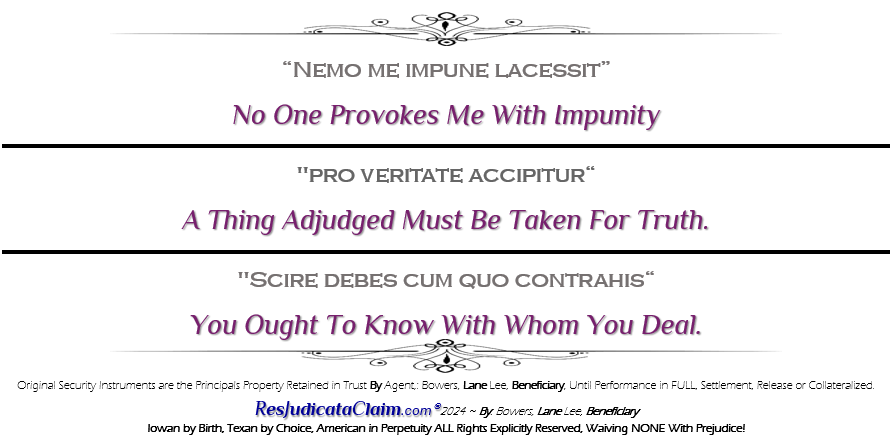
cum quo contrahis. You ought
to know with whom
you deal.
=
= = = = = = = = = = = = = = = = = = = = = = = = =
MAXIMs
concerning Contracts, Specifically to this NOTICE :
=
= = = = = = = =
Ei
incumbit probatio qui dicit, non qui negat. The burden of the proof lies upon him
who affirms, not he
who denies. Dig. 22, 3, 2; Tait on Ev. 1; 1 Phil. Ev. 194; 1
Greenl.
Ev. 74; 3 Louis. R. 83; 2 Dan. Pr. 408; 4 Bouv Inst. n. 4411. Dig. 16,
3, 1, 6.
Conventio
vincit legem. The
agreement of the parties overcomes or prevails against the law.
Story, Ag. See Dig. 16, 3, 1, 6.
Ex
facto jus oritur. Law arises
out
of FACT;
that is, its application must be to FACTs.
Expressum
facit cessare tacitum. What
is expressed renders what is implied silent.
Facta
sunt potentiora verbis. FACTs
are more powerful than words.
Facultas
probationum non est angustanda. The faculty or right of offering
proof is not to be
narrowed. 4 Co. Inst. 279.
Justitia
non est neganda, non differenda. Justice is not to be denied nor
delayed. Jenk.
Cent. 93.
Cum
adsunt testimonia rerum quid opus est verbis. When the proofs of FACT
are present, what need is there of
words. 2
Buls. 53.
Equity
looks upon that as done, which
ought to be done.
4 Bouv. Inst. n. 3729; 1 Fonbl. Eq. b. 1, ch. 6, s.
9, note; 3 Wheat. 563.
Error
juris nocet. Error of law is
injurious. See
4 Bouv. Inst. n.
3828.
Forstellarius
est pauperum depressor, et totius communitatis et
patriae publicus inimicus. A
forestaller is an
oppressor of the poor, and a public enemy to the whole community and
the
country. 3
Co. Inst. 196.
Id
quod nostrum est, sine facto nostro ad alium transferi non
potest. What belongs to us
cannot be transferred
to another without our consent. Dig. 50, 17, 11. But
this must
be understood with this qualification, that the government may take
property
for public use, paying the owner its value. The title to
property may
also be acquired, with the consent of the owner, by a judgment of a
competent
tribunal.
Id
possumus quod de jure possumus. We
may do what is allowed by law. Lane, 116.
Judicia
sunt tanquam juris dicta, et pro veritate accipiuntur. Judgments are, as it were, the dicta
or sayings of the
law, and are received as truth. 2 Co. Inst. 573.
Judicium
non debet esse illusorium, suum effectum habere debet. A judgment ought not to be illusory,
it ought to have its
consequence. 2 Inst. 341.
Judicium
semper pro veritate accipitur. A judgment is always taken for truth. 2 Co. Inst. 380.
Legatos
violare contra jus gentium est. It is contrary to the law of nations
to violate the rights of
ambassadors.
Legibus
sumptis disinentibus, lege naturae utendum est. When laws imposed by the state fail,
we must act by the
law of nature. 2
Roll. R. 298.
Lex
non requirit verificare quod apparet curiae. The law does not require that to be
proved, which is
apparent to the court. 9 Co. 54.
Maleficia
non debent remanere impunita, et impunitas continuum
affectum tribuit delinquenti. Evil
deeds ought
not to remain unpunished, for impunity affords continual excitement to
the
delinquent. 4
Co. 45.
Malum
hominun est obviandum. The
malice of men is to be avoided. 4
Co. 15.
Nihil
possumus contra veritatem. We
can do nothing against truth. Doct.
& Stu. Dial. 2, c. 6.
Nihil
quod est contra rationem est licitum. Nothing against reason is lawful. Co. Litt. 97.
Non
Licet quod dispendio licet. That
which is permitted only at a loss, is not permitted to be done. Co. Litt. 127.
Non
quod dictum est, sed quod factum est, inspicitur. Not what is said, but what is done,
is to be regarded. Co.
Litt. 36.
Non
solum quid licet, sed quidest conveniens considerandum, quia
nihil quod inconveniens est licitum. Not only
what is permitted, but what is proper, is to be considered, because
what is
improper is illegal. Co.
Litt.
66.
Novum
judicium non dat novum jus, sed declarat antiquum. A new judgment does not make a new
law, but declares the
old. 10 Co. 42.
Paci
sunt maxime contraria, vis et injuria. Force and wrong are greatly contrary
to peace. Co.
Litt. 161.
Pacta
privata juri publico derogare non possunt. Private contracts cannot derogate
from the public law.
7 Co. 23.
Derogation
is the partial repeal or abrogation of a
law by a later act that limits its scope or impairs its utility and
force. It
is sometimes used to mean abrogation, as in the legal maxim "lex
posterior derogat priori" A
subsequent law
derogates the previous one.
Pacto
aliquod licitum est, quid sine pacto non admittitur. By a contract something is permitted,
which, without it,
could not be admitted. Co. Litt. 166.
Parum
est latam esse sententiam, nisi mandetur executioni. It is not enough that sentence should
be given unless it
is put in execution. Co. Litt. 289.
Peccata
contra naturam sunt gravissima. Offences against nature are the
heaviest. 3
Co. Inst. 20.
Peccatum
peccato addit qui culpae quam facit patrocinium
defensionis adjungit. He
adds one offence to
another, who, when he commits a crime, joins to it the protection of a
defence.
5 Co. 49.
Perspicua
vera non sunt probanda. Plain
truths need not be proved. Co.
Litt. 16.
Pirata
est hostis humani generis. A
pirate is an enemy of the human race. 3
Co. Inst. 113.
Plus
peccat auctor quam actor. The
instigator of a crime is worse than he who perpetrates it. 5
Co. 99.
Volunti
non fit injuria. He who
consents cannot receive an injury. 2
Bouv. Inst. n. 2279, 2327; 4 T. R. 657; Shelf. on mar. & Div. 449.
Paen
ad paucos, metus ad omnes perveniat. A punishment inflicted on a few,
causes a dread to all.
22 Vin. Ab. 550.
Paen
ad paucos, metus ad omnes. Punishment
to few, dread or fear to all.
Potentia
non est nisi ad bonum. Power
is not conferred, but for the public good.
Potentia
debet sequi justiciam, non antecedere. Power ought to follow, not to precede
justice. 3
Buls. 199.
Praestat
cautela quam medela. Prevention
is better than cure. Co.
Litt.
304.
Principia
probant, non probantur. Principles
prove, they are not proved. 3 Co.
40. See Principles.
Principiorum
non est ratio. There
is no reasoning of principles. 2
Buls. 239. See Principles.
Principium
est potissima pars cujusque rei. The principle of a thing is its most
powerful part.
10 Co. 49.
Prior
tempore, potior jure. He who
is before in time, is preferred in right.
Protectio
trahit subjectionem, subjectio projectionem. Protection draws to it subjection,
subjection,
protection. Co.
Litt. 65.
Proviso
est providere praesentia et futura, non praeterita. A proviso is to provide for the
present and the future,
not the past. 2
Co. 72.
Quae
communi legi derogant stricte interpretantur. Laws which derogate from the common
law ought to be
strictly construed. Jenk.
Cent.
231.
Quae
contra rationem juris introducta sunt, non debent trahi in
consequentiam. Things
introduced contrary to the
reason of the law, ought not to be drawn into precedents. 12
Co. 75.
Quae
dubitationis caus tollendae inseruntur communem legem non
laedunt. Whatever is
inserted for the purpose of
removing doubt, does not hurt or affect the common law. Co. Litt. 205.
Quae
inter alios acta sunt nemini nocere debent, sed prodesse
possunt. Transactions
between strangers may
benefit, but cannot injure, persons who are parties to them.
6 Co.
1.
Quod
est inconveniens, aut contra rationem non permissum est in
lege. What is inconvenient
or contrary to
reason, is not allowed in law. Co. Litt. 178.
Quod
non legitur, non creditor. What
is not read, is not believed. 4
Co. 304.
Quod
per recordum probatum, non debet esse negatum. What is proved by the record, ought
not to be denied.
Tacita
quaedam habentur pro expressis. Things
silent are sometimes considered as expressed. 8 Co. 40.
Ubi
culpa est ibi paena subesse debet. Where
there is culpability, there punishment ought to be.
Ubi
jus incertum, ibi jus nullum. Where
the law is uncertain, there is no law.
ubi
quis delinquit ibi punietur. Let
a man be punished when he commits the offence. 6 Co. 47.
Ubicunque
est injuria, ibi damnum sequitur. Wherever there is a wrong, there
damages follow. 10
Co. 116.
Ut
paena ad paucos, metus ad omnes perveniat. That by the punishment of a few, the
fear of it may
affect all. 4 Inst. 63.
Vreba
aliquid operari debent, verba cum effectu sunt accipienda. Words are to be taken so as to have
effect. Bacon's
Max. Reg. 3, p. 47. See 1 Duer. on ins.
210, 211, 216.
Vani
timores sunt aestimandi, qui non cadunt in constantem virum. Vain are those fears which affect not
a valiant man. 7
Co. 27.
Verba
generalia generaliter sunt intelligenda. General words are to be generally
understood. 3
Co. Inst. 76.
Quae
malasunt inchoata in principio vex bono peragantur exitu. Things bad in the commencement seldom
end well. 4
Co. 2.
=
= = = = = = = = = = = = = = = = = = = = = = = = =
TO:
Public Office Holders, Oath's of Office and
Principals Responsibility, Specifically
to this NOTICE :
=
= = = = = = = =
Non
est arctius vinculum inter homines quam jusjurandum. There is no stronger link among men
than an oath.
Jenk. Cent. 126.
Juramentum
est indivisibile, et non est admittendum in parte verum
et in parte falsam. An oath
is indivisible, it
cannot be in part true and in part false.
Officium
nemini debet esse damnosum. An
office ought to be injurious to no one.
Omne
sacramentum debet esse de certa scienti. Every oath ought to be founded on
certain knowledge. 4
Co. Inst. 279.
Judicium
semper pro veritate accipitur. A judgment is always taken for truth. 2 Co. Inst. 380.
Qui
facit per alium facit per se. He
who acts by or through another, acts for himself. 1 Bl. Com. 429; Story, Ag.
440; 2 Bouv. Inst. n.
1273, 1335, 1336; 7 Man. & Gr. 32, 33.
In
maleficio ratihabitio mandato comparatur. He who ratifies a bad action is
considered as having
ordered it. Dig. 50, 17, 152, 2.
Qui
molitur insidias in patriam, id facit quod insanusnauta
perforans navem in qua vehitur. He who betrays
his country, is like the insane sailor who bores a hole in the ship
which
carries him. 3
Co. Inst. 36.
Qui
non obstat quod obstare potest facere videtur. He who does not prevent what he can,
seems to commit the
thing. 2 Co. Inst. 146.
Qui
non prohibit quod prohibere potest assentire videtur. He who does not forbid what he can
forbid, seems to
assent. 2 Inst. 305.
Qui
non propulsat injuriam quando potest, infert. He who does not repel a wrong when he
can, induces it. Jenk.
Cent. 271.
Qui
per alium facit per seipsum facere videtur. He who does anything through another,
is considered as
doing it himself. Co. Litt. 258.
Qui
potest et debet vetare, jubet. He
who can and ought to forbid, and does not, commands.
Omnia
praesumuntur legitime facta donec probetur in contrarium. All things are presumed to be done
legitimately, until
the contrary is proved.
Co. Litt.
232.
Omnis
interpretatio si fieri potest ita fienda est in
instrumentis, ut omnes contrarietates amoveantur. The
interpretation of instruments is to be made, if they will admit of it,
so that
all contradictions may be removed. Jenk. Cent. 96.
Oportet
quod certa res deducatur in judicium. A thing, to be brought to judgment,
must be certain or
definite. Jenk.
Cent. 84.
Qui
primum peccat ille facit rixam. He
who first offends, causes the strife.
Qui
tacet consentire videtur. He
who is silent appears to consent. Jenk.
Cent. 32.
Quicpuid
acquiritur servo, acquiritur domino. Whatever is acquired by the servant,
is acquired for the
master. 15 Bin. Ab. 327.
Qnicquid
est contra normam recti est injuria. Whatever is against the rule of
right, is a wrong. 3
Buls. 313.
Reputatio
est vulgaris opinio ubi non est veritas. Reputation is a vulgar opinion where
there is no truth.
4 Co. 107. But see, Character.
Res
judicata pro veritate accipitur. A
thing adjudged must be taken for truth. Co.
Litt. 103; Dig. 50, 17, 207. See Res judicata.
Res
judicata facit ex albo nigrum, ex nigro album, ex curvo
rectum, ex recto curvum. A
thing adjudged makes
what was white, black; what was black, white; what was crooked
straight; what
was straight, crooked. 1 Bouv. Inst. n. 840.
Respondeat
superior. Let the
principal answer. 4
Co. Inst.
114; 2 Bouv. Inst. n. 1337; 4 Bouv. Inst. n. 3586.
Rights
never die.
Reus
laesae majestatis punitur, ut pereat unus ne pereant omnes. A traitor is punished, that by the
death of one, all may
not perish. 4
Co. 124.
Quando
do una et eadem re, duo onerabiles existunt, unus, pro
insufficientia alterius, de integro onerabitur. When
two persons are liable on a joint obligation, if one makes default the
other
must bear the whole. 2
Co. Inst.
277.
Receditur
a placitis juris, potius quam injuriae et delicta
maneant impunita. Positive
rules of law will be
receded from, rather than crimes and wrongs should remain unpunished. Bacon's Max. Reg. 12. This
applies only to
such maxims as are called placita juris; these will be dispensed with
rather
than crimes should go unpunished, quia salus populi suprema lex, because the public safety is the
supreme law.
=
= = = = = = = = = = = = = = = = = = = = = = = = =
TO:
The Ignorant of What is Right and What is Law, Specifically
to this NOTICE :
=
= = = = = = = =
Idem
est scire aut scire debet aut potuisse. To be able to know is the same as to
know. This maxim is
applied to the duty of every one to know the law.
Ignorantia
excusatur, non juris sed facti ~&~ Ignorantia legis
neminem excusat. Ignorance
of FACT may excuse,
but not ignorance of law. 4 Bouv.
Inst. n. 3828. See Ignorance.
Ignorantia
facti excusat, ignorantia juris non excusat. Ignorance of FACTs excuses, ignorance
of law does not
excuse. 1 Co. 177; 4 Bouv. Inst. n 3828. See Ignorance.
Imperitia
culpae annumeratur. Ignorance,
or want of skill, is considered a negligence, for which one who
professes skill
is responsible. Dig.
50, 17, 132;
1 Bouv. Inst. n. 1004.
Impunitas
continuum affectum tribuit delinquenti. Impunity offers a continual bait to a
delinquent. 4
Co. 45.
Scientia
sciolorum est mixta ignorantia. The knowledge of smatterers is mixed
ignorance. 8
Co. 159.
Scientia
utrimque per pares contrahentes facit. Equal knowledge on both sides makes
the contracting
parties equal.
Scire
leges, non hoc est verba eorum tenere, sed vim et
potestatem. To know the
laws, is not to observe
their mere words, but their force and power. Dig. 1, 3, 17.
Spes
impunitatis continuum affectum tribuit delinquendi. The hope of impunity holds out a
continual temptation to
crime. 3 Co.
Inst. 236.
Stabit
praesumptio donec probetur in contrarium. A presumption will stand good until
the contrary is
proved. Hob.
297.
When
the common law and statute law
concur, the common law is to be preferred.
4
Co. 71.
=
= = = = = = = = = = = = = = = = = = = = = = = = =
MAXIMs Concerning Lane’s INTENT and NECESSITY of COUNTERCLAIM, Specifically to this NOTICE :
=
= = = = = = = =
Sequi
debet potentia justitiam, non praecedere. Power should follow justice, not
precede it. 2
Co. Inst. 454.
Vana
est illa potentia quae numquam venit in actum. Vain is that power which is never
brought into action. 2
Co. 51.
Quod
est necessarium est licitum. What
is necessary is lawful.
Quod
meum est sine me auferri non potest. What is mine cannot be taken away
without my consent. Jenk.
Cent. 251. Sed vide Eminent Domain.
Ubi
jus, ibi remedium. Where
there
is a right, there is a remedy. 1
T. R. 512; Co. Litt. 197, b; 3 Bouv. Inst. n. 2411; 4 Bouv. Inst. n.
3726.
Scribere
est agere. To write is to
act. 2 Roll. R. 89.
Vigilantibus
et non dormientibus serviunt leges. The laws serve the vigilant, not
those who sleep upon
their rights. 2 Bouv. Inst. n. 2327. See Laches.
Semper
necessitas probandi incumbit qui agit. The claimant is always bound to
prove: the burden of
proof lies on him.
Error
qui non resistitur, approbatur. An
error not resisted is approved. Doct. & Stud. c. 70.
Errores
ad sua principia referre, est refellere. To refer errors to their origin is to
refute them.
3 Co. Inst. 15.
Illud
quod alias licitum non est necessitas facit licitum, et
necessitas inducit privilegium quod jure privatur. That
which is not otherwise permitted, necessity allows, and necessity makes
a
privilege which supersedes the law. 10
Co. 61.
Necessitas
non habet legem. Necessity
has no law. Plowd.
18. See
Necessity, and 15 Vin. Ab. 534; 22 Vin. Ab. 540.
Melius
est omnia mala pati quam malo concentire. It is better to suffer every wrong or
ill, than to
consent to it. 3 Co. Inst. 23.
Necessitas
vincit legem. Necessity
overcomes the law. Hob.
144.
Necessitas
inducit privililegium quoad jura privata. Necessity gives a preference with
regard to private
rights. Bacon's Max. REg. 5.
Lex
semper dabit remedium. The
law
always gives a remedy.
3 Bouv.
Inst. n. 2411.
Probandi
necessitas incumbit illi ui agit. The necessity of proving lies with
him who makes the
charge.
Probationes
debent esse evidentes, id est, perspicuae et faciles
intelligi. Proofs ought to
be made evident, that
is, clear and easy to be understood. Co. Litt. 283.
Nemo,
qui condemnare potest, absolvere non potest. He who may condemn may acquit. Dig. 50, 17, 37.
Quod
est ex necessitate nunquam introducitor, nisi quando
necessarium. What is
introduced of necessity, is
never introduced except when necessary. 2 Roll. R. 512.
Verba fortius accipientur contra proferentum. Words are to be taken most strongly against him who uses them. Bacon's Max. Reg. 3; 1 Bouv. Inst. n. 661.
Quae cohaerent personae person separari nequeunt. Things which belong to the person ought not to be separated from the person. Jenk. Cent. 28.
Maxims of Equity
“Aequitas sequitir legem.” Equity follows the law. 1 Story, Eq. Jur. 64; 3 Wooddes. Lect. 479, 482.
Equity will not suffer a wrong to be without a remedy.
He who comes into equity must come with clean hands.
Equity will not allow a remedy that is contrary to law.
Equity will take jurisdiction to avoid a multiplicity of suits.
Equity will not allow a statute to be used as a cloak for fraud.
Equity regards the beneficiary as the true owner.
“Vigilantibus non dormientibus aequitas subvenit.” Equity aids the vigilant, not those who slumber on their rights.
Equity acts in personam or persons.
Equity delights
to do justice and not by halves.
“A verbis legis non est recedendum.” From the words of the law there must be no departure.
“Actus Dei nemini facit injuriam.” The act of God does no injury; that is, no one is responsible for inevitable accidents.
“Augupia
verforum sunt judice indigna.” A twisting of language is unworthy of a
judge.
“Catalla just possessa amitti non possunt.” Chattels justly possessed
cannot be lost.
“Contractus legem ex conventione accipiunt.” The agreement of the parties makes the law of the contract.
“Culpa lata aequiparatur dolo.” A concealed fault is equal to a deceit.
“Cum adsunt testimonia rerum quid opus est verbis?” When the proofs of facts are present, what need is there for words?
“Debet qui juri subjacere ubi delinquit.” Every one ought to be subject to the law of the place where he offends.
“Ejus est non nolle qui potest velle.” He who may consent tacitly may consent expressly.
“Ex facto jus oritur actio exteriora indicant interiora secreta.” Law arises out of fact; that is, its application must be to facts. 8 Co. R. 146.
“Actio exteriora indicant interiora secreta.” External actions show internal secrets. 8 Co. R. 146.
“Actor qui
contra regulam quid adduxit non est audiendus.” He ought not to
be heard who advances a proposition contrary to the rules of law.
“Actore non probante reus absolvitur.” When the plaintiff does not prove his case, the defendant is absolved.
“Argumentum simili valet in lege.” An argument drawn from a similar case or analogy avails in law. Co. Litt. 191


'There is NO Immunity or Exemption for Deliberate Lawlessness'